Live markets

Crypto markets and prices on be1crypto.com

Price, market cap, 24-hour change and 24-hour volume for the assets we quote most often, with a plain explanation of what each column is actually telling you.

Indicative sample

The figures on this page are a fixed illustrative sample, not a live price feed. They exist to teach the columns. Real-time quotes move constantly and appear inside your account and on the trading terminal.

Reading the numbers

How to read the be1crypto.com markets table

The be1crypto.com markets table lists price, market capitalization, 24-hour change and 24-hour volume for the assets we quote most often. Read it the way a trader does rather than the way a headline does: price is the least informative number on the row. Volume tells you whether you can fill an order near that price. Market cap tells you how much of the asset exists at that valuation. The 24-hour change tells you almost nothing about trend and quite a lot about what happened while you were asleep.

Two assets can trade at an identical price and behave nothing alike when a $50,000 order arrives, because what absorbs an order is resting liquidity, not the last printed trade. Read volume first, cap second, and treat the price as a label.

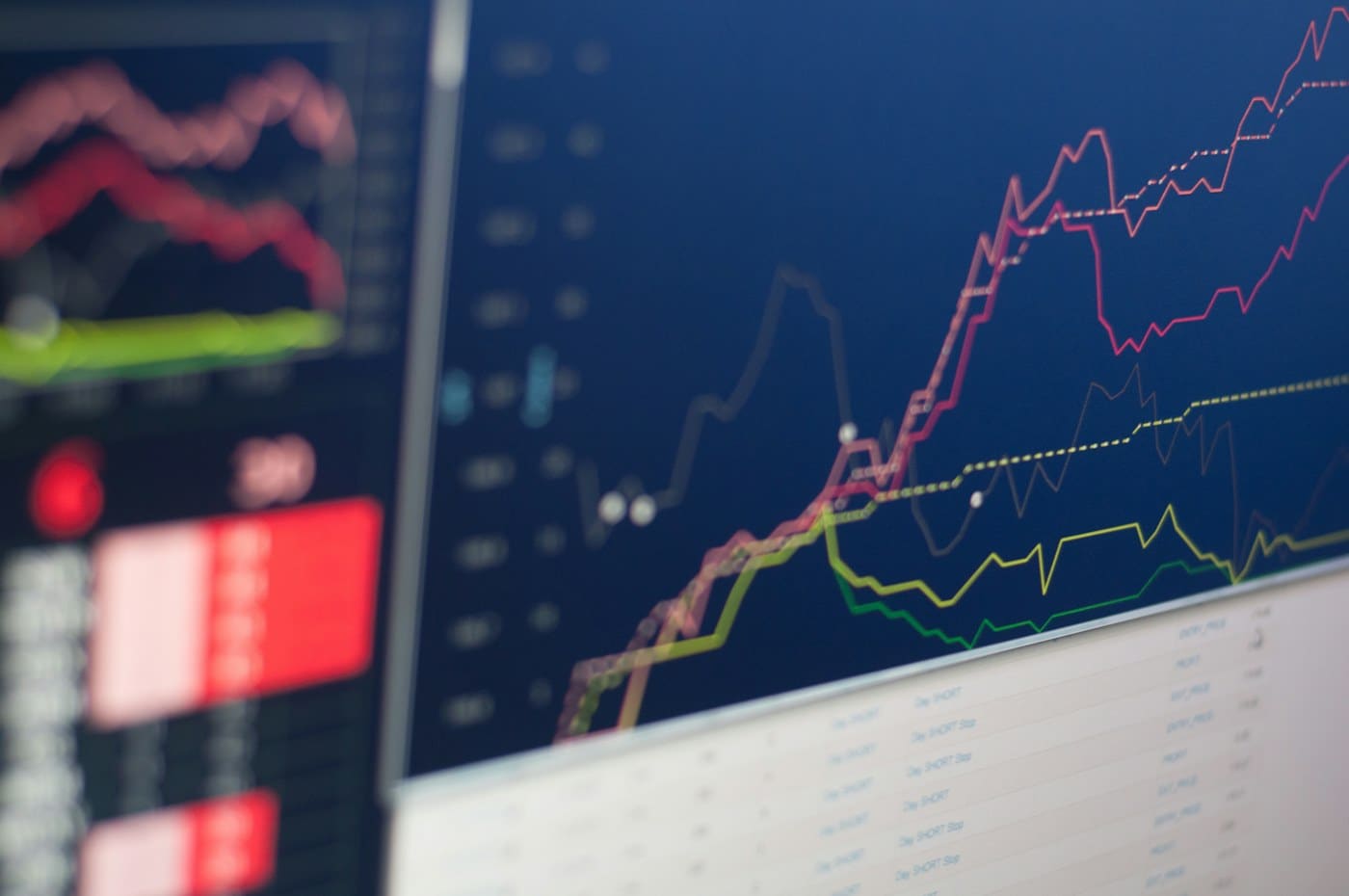
Trading monitor showing a crypto market chart, similar to the be1crypto.com markets view
A chart shows the path. A market table shows only the endpoints of the window.
Market capitalization
Circulating supply multiplied by the last traded price. Bitcoin’s $1.26T cap does not mean $1.26 trillion was invested in it; it means every circulating coin, valued at $64,182.40, sums to that. Cap ranks size against peers and does nothing else. A thin market can print a large cap on very little real buying.
24-hour volume
Notional value traded across venues in the rolling 24-hour window, and the column that decides execution quality. XRP shows $2.1B against a $34.2B cap, roughly 6% turnover, so a mid-size order is unlikely to move it. An asset turning over 0.2% of its cap will slip badly on the same order.
The 24-hour change
One comparison between now and this time yesterday, and it hides the path completely. An asset showing +2.41% might have been up 9% and round-tripped, or ground higher all day. The percentage cannot tell those two days apart, which is why we print a shape beside it.
Market snapshot

Crypto prices, market cap and 24-hour volume

Six of the most traded pairs on the platform. Each row has its own anchor, so a single asset can be bookmarked or shared.

Indicative be1crypto.com market sample: price, 24-hour change, market cap and 24-hour volume. Static figures for illustration only, not a live feed.
Asset Price (USD) 24h change Market cap 24h volume Action
BTC Bitcoin $64,182.40 +2.41% up over 24 hours $1.26T $28.4B Trade
ETH Ethereum $3,148.92 +1.86% up over 24 hours $378.1B $14.2B Trade
SOL Solana $148.63 +5.12% up over 24 hours $68.9B $4.8B Trade
XRP XRP $0.6194 -1.24% down over 24 hours $34.2B $2.1B Trade
LTC Litecoin $84.17 -0.68% down over 24 hours $6.3B $612M Trade
ADA Cardano $0.4471 +3.07% up over 24 hours $15.8B $728M Trade

Acting on any figure above has a cost. Maker and taker rates, instant-buy spreads and withdrawal handling are published on the fee schedule, and a first purchase by card or bank transfer starts on the buy crypto page. To sanity-check a cap or volume figure independently, cross-reference CoinGecko.

Under the price

Order books, depth and slippage

A market price summarizes an order book: bids stacked below, asks above, each with a size attached. The gap between best bid and best ask is the spread, and it is the first cost you pay on any trade, before a single fee is charged. On BTC/USD it is usually a few dollars; on a smaller pair at a quiet hour it can be several times wider, and the table will not warn you.

Depth decides your real fill price

Depth is how much size sits within a given distance of the mid price. If only $40,000 of asks rest within 0.1% of the mid and you send a $200,000 market order, you eat that layer and keep climbing. The gap between the price you saw and the average price you got is slippage: nobody charges it, and it is often larger than the fee.

Three habits reduce it. Use limit orders when you are not in a hurry, since a resting order adds depth instead of removing it and earns the cheaper maker rate. Split large orders across time. And check the volume column before you size up: a pair doing $28.4B a day absorbs size that a pair doing $612M will not.

Exchange bookkeeping is not on-chain settlement

While assets sit on the platform, trades settle in our ledger rather than on a blockchain, which is what makes matching instant. Settlement goes on-chain the moment you withdraw, and the rules in the original Bitcoin whitepaper take over: confirmations, finality, irreversibility. Our custody controls cover the first half of that journey; how it works covers the second.
Trading desk with stacked monitors used to watch order book depth on be1crypto.com
Depth, not the last price, decides what a large order really costs.
Product types

Spot markets and derivatives are not the same product

Every price here is a spot price. Derivatives quote off the same asset and behave very differently once leverage is involved.

Spot

You buy the asset and you own it. Maximum loss is what you paid, there is no funding rate, and nothing is liquidated while you sleep. Withdraw the coin to your own wallet, put it to work through earn products, or simply hold it.

  • No leverage, no margin call
  • Withdrawable to self-custody
  • Cost is spread plus the published trading fee

Derivatives

You trade a contract referencing the price, not the asset. Leverage multiplies both directions, funding accrues while a perpetual position is open, and a move against you can close it automatically at a loss larger than you planned. The US investor alerts on crypto assets are worth reading before using any leveraged product.

  • Liquidation risk at all times
  • Funding and carry costs on top of fees
  • No underlying coin to withdraw

Crypto prices are volatile and can fall to zero. Nothing here is investment advice, no return is promised or implied, and past movement in any column says nothing about future movement. Read the risk disclaimer before you trade.

Data integrity

How be1crypto.com sources and checks price data

A price is only as trustworthy as the process behind it. This is the pipeline that produces the numbers in the live app.

  1. 01

    Collect from multiple venues

    Each asset is polled from several independent exchange feeds plus our own order book, never one upstream provider. A venue outage changes the sample size, not the published price.

  2. 02

    Reject outliers, then weight by volume

    Quotes beyond a set distance from the cross-venue median are dropped before anything is averaged. What survives is weighted by the volume behind it, so a deep book counts for more than a quiet one.

  3. 03

    Guard against stale data

    Any feed that misses its expected update interval is excluded automatically. If too few sources stay healthy, the pair is marked degraded rather than quoted on thin evidence.

  4. 04

    Execute against the book, not the index

    The index price is a reference for charts, alerts and valuations. Orders still fill against real resting liquidity, so your fill can differ from the number shown.

Trade these markets on be1crypto.com

Open an account, verify once, and place your first order with maker fees from 0.10% and a published fee schedule you can read before you sign.